Introduction
Following the calculation of the money necessary to supply the technology necessary to create a Saharan forest, the money involved in ensuring human resources must also be considered. We have already explored ways that solar panel energy and methods of converting seawater into fresh water, but all this means nothing if we do not have to workforce to build the forest. This is a very large project, and so a very large workforce will be necessary. However, if we draw upon the disadvantaged members of the countries that will be most affected by the forest’s creation, this can bring a gigantic boost to their economies, and the large costs will have many positive effects. Ultimately, improving the climate around the region in this way will be a previously unseen project of massive funds and operation, but it will improve the quality of life for those who will be most involved in the project, as well as those around the world.
How many people does it take to plant one hectare of trees?
According to the NHS, one hectare can take up 1000 to 2500 trees. According to my previous calculations, I need 40 billion trees to equalise the Carbon Dioxide being released into the atmosphere each year. This means that I will need 40 million hectares for my forests. Although this question is dependent on many variables and would vary by person and situation, I would estimate that the average person could plant about 500 trees a day, which means that 2-5 people could plant one hectare of trees. If I spread my plans across two years, with 30 days off, I would need 114,286 people to help plant the trees. 40 billion divided by 500 is 80 million, divided by 700 (the amount of days in two years minus 30) is 114,286.
How many people does it take to look after one hectare of trees?
When considering this question, my initial figure used the same logic as the above question, and assigned 500 trees to every one person to maintain. I came up with a figure of 80 million people. However, it has been noted that many of my chosen trees do not need much maintenance, especially after the initial period after the tree has been planted. For example, the Mountain Mahogany needs very little maintenance, and the Eucalyptus and Neem trees grow very fast and therefore wouldn’t need maintenance for long either. Therefore, the maintenance level would vary across the different species, and a lower number of employees would probably be necessary. I also realised that, given the right technology, it is possible that each maintainer could look after two hectares. Perhaps this figure could be larger, depending on the technology they are given and as the trees age. At the very least, I would quarter my initial figure to 20 million. Of course, this number only applies once all the trees have been planted – within the two years it would take to plant all the trees, numbers to maintain the trees would start out low, and then grow. The maintenance jobs could be considered as farming jobs, with each person caring over their plot of land, and would therefore positively impact many employees lives as a positive and secure job. This would also ensure places of residence for many of the workers.
How many hectares of trees are we planting?
In my previous research, I had calculated that we would need 40 billion trees in order to comfortably equal out the human emissions of CO2. This, I had calculated, would roughly equate to 40 million hectares of land. Although this appears to be a very large amount of land to convert to forest, my plans ensured that I avoided as many large cities as possible, and the large amount of employees necessary would mean that the forest area could become home for many citizens, and replace the unproductive area of desert.
How many people will we need?
Adding both the amount of people needed to plant the trees, and the maximum amount of people I believe would be necessary to maintain the forest for as long as is necessary, there could be as much as 20,114,286 people employed for this project. This does not include the people who will be employed to complete any other jobs that would be necessary, except for planting and maintenance.
How many people does it take to look after that many people – what city/cities/country is this equivalent to?
According to my research, in an ideal work situation, there will be one supervisor for every 15-20 people. If there is one for every 20 people, this will make 4,005,333 supervisors employed to take care of the workers. Adding this to the previous amount of employees needed, I come to the final figure of 24,119,619, which may rise or fall depending on unforeseeable circumstances. This figure is almost one quarter of Egypt’s population of 100.4 million. Although this seems overwhelmingly large, the unemployment rate in Algeria is 12.83% (5,523,315), 10.45% of Egypt (10,491,800), 17.70% of Sudan (7,577,370), 7.8% of Mali (1,533,480), and 9.88% of Mauritania (446,576), which makes 25,572,541. Therefore, this project could significantly improve the unemployment rate of these countries, as well as those who are below the poverty line, if these people are given a chance at employment with this project. Similar projects have seen great involvement of local people in planting trees in African countries; Eden Reforestation Projects recognized a link between deforestation and poverty, and therefore employed many locals successfully to help battle both problems. This project is across Madagascar, Haiti, Nepal, Mozambique, Kenya and many other countries, and they are planting trees at a rate of 20 million trees a month. This project will mobilise local workforces in a much more condensed area, which will hopefully mean that it will be more effective in helping those in poverty.
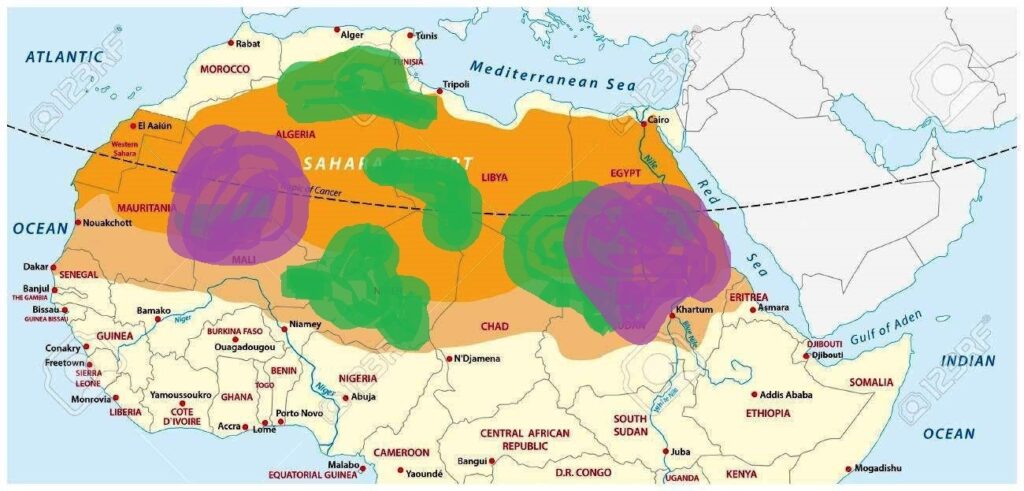
In the rough plan for my forests in the image above (indicated by the purple areas are the areas where my forests could possibly be placed), the countries who could be affected most by the forest plans will be Sudan, Egypt, Algeria, Mali and Mauritania. It is my suggestion that it is from these countries that the vast majority of the employees are drawn from, an aspect which will benefit people in areas that will have suffered from the drought of the Saharan Desert in their countries.
To give some kind of an idea of how much it would cost to employ all these people, the average salary in Egypt is $8,318.73, or £6,107.57. This, of course, would vary depending on country and position. However, if we multiply this figure with the amount of people that may be employed, we come to a figure of £122,849,409,745 yearly, which would be brought back into the economies of all the countries the employees come from, ultimately providing a positive impact.
Conclusion
Although this appears to be a large amount of people to care for and pay wages for, this kind of large forestation project has been shown to make a great impact on local communities. As of April 2020, for example, 2,940 people were employed in two regions in Nepal for an Amazon reforestation programme, which helped people who had been suffering from deforestation in the first place. In a similar project in Kenya, about 80% of the employees were women, a pattern which ensures that disadvantaged women benefit the most from the employment included in forest projects. Therefore, in conclusion, this dedication to the project in costs and land and time will not only improve the climate of the world, but could transform and improve the economies of those countries who will be directly affected.
| People to plant trees | 114,286 |
| People to maintain trees | 20,000,000 |
| People to supervise people | 4,005,333 |
| Total | 20,114,286 |
Information found from
https://treesisters.org/blog/the-social-impact-of-tree-planting