- Moving water
- Diverting water for domestic water use
- Transportation of goods and people
- Solving problems of Droughts
- Irrigate Agriculture fields and farms
- Tourism
- Hydroelectric Power Generation
Expand on uses of Canal
According to the environmental agency in the UK, it has been predicted that there will not be enough water supply for the next 25 years due to climate change and rapid population growth. Environmentalists and scientists had called on the UK public to reduce water use, and focus on increasing the efficiency of water use. Current situation has urged everyone to use water wisely at home. There is a study that shows that at present, there is an average 140 liters of water used by british on a daily basis. To meet the needs of more than 20 million people within the next 25 years, everyone needs to reduce their amount of water usage to 100 liters per day.
In 2016, about 9500 billion litres of water were diverted from lakes, rivers and reservoirs, which is enough to cover greater London in nearly 6 metres of water. In addition, there is about 3 billion litres of water waster through leakage. Water leaking from the pipes puts a significant pressure on already scarce water resources and the environment. There are a certain number of leagues that are unavoidable and expected and allowed during planning. Although leaked water eventually returns to the natural environment, it adds to abstraction pressures and wastes the energy used in treating and cleaning it. Water is also being extracted from underground. It has been reported by the Environmental agency, that 28% of the groundwater bodies are not at a sustainable level, this can not only lead to groundwater contamination but also bring into more risks of land subsidence causing above ground infrastructure destruction and putting residents in danger.
There are major issues that remain in the public attitudes towards water use. The problem of the UK facing severe water shortage is not being clearly addressed to the public, so it is everyone’s duty to cut the amount of water being used daily. According to the survey, 10% of the public consider water consumption a key environmental consideration, this ranks below plastic pollution, energy consumption and generation of food waste, and carbon footprints. The chief Executive of England’s environment agency, Sir James Bevan said that people are still masked under the stereotypical reputation for rainy UK, the public don’t believe that such a wet country could reach a tipping point where demand for water outstrips in only 25 years. But there is no time for us to think, if people in the UK don’t take action, it may become a reality. But if people all take concerted action now, it can be ensured that there will be enough water to go around for the next generation to come. The coronavirus outbreak in 2020, however, raised the appreciation of water use in the UK. The report found that there are 83% of people who appreciate the access of clean water so they can wash their hands, 82% of people now are thankful about the natural world during the lockdown, while 76% are more aware of the impact that they have on the natural environment. Lastly, with 69% of respondents claiming to be more concerned about the environment and sustainability, the report is calling on the public to reduce water usage on a daily basis.
Beside the public attitudes toward the current water situation in the UK, the worsening climate change also serves as a catalyst in the water crisis in the UK. Increasing temperature will affect the timing and the amount of rainfall that arrives, which slows down the process of groundwater replenishment and riverflow rechange. According to the NAO, 600 million liter per day are lost due to warm temperature and the current overconsumption of around 480 million liter per day, the NAO claims this is equivalent to 7% of the county’s total annual water supply. The report from the environmental agency also warned that increased stagnant water during the droughts coupled with increased temperature could see the spread of mosquito borne diseases such as dengue fever and west virus. According to the Environmental agency in the UK, current levels of abstraction ofent leave little room for possible increase in meeting the demands. There are significant demands on water supplies across the country, not only in the drier parts of the south-east and east. After taking into consideration current licenses and environmental demands, there are just a few regions of the nation where extra water is always accessible. Even in places that are typically believed to be water-rich, such as the north-west and south. I believe that if the canal is built successfully, it will help to ease the water deficit in the south by channeling water from Scotland’s water-rich north. Definition of Canals are man-made waterways that allow ships and barges to go from one body of water to another. They can also be used to provide water to houses and other human uses. As airplanes and high-speed trains gain popular acceptance, we see a much more developed transportation infrastructure. Canals have become less popular, but they continue to serve an important role as transit corridors and facilitators of global trade. The world-famous canals, the Panama Canal and the Suez Canal serve as great examples in connecting global commerce. Waterways are the navigable sections of a body of water that can be found within a port or out in the open sea, connect two or more bodies of water, or even create networks within a city. Aqueducts are used to transfer water for drinking, irrigation, and hydroelectric power generation.
Irrigational Canal
An irrigation canal as its name implies, it is constructed to convey water from the source of supply to one or more farms.
The goal of building irrigation canal is to provide water to farm irrigation systems. The practice’s goals are to decrease erosion, avoid water quality deterioration, and increase water efficiency by minimizing transportation losses due to leakage or structural failure.
Power Canal
A power canal refers to a canal used for hydraulic power generation, rather than for trasport of goods. The power canal was major factor in the Industrial revolution in New England in the 19th century. A power canal is a canal that is utilized for generating hydraulic power instead of transporting commodities. In the 19th century, the power canal was a key component of New England’s Industrial Revolution. As electricity (transported by power lines) superseded the requirement for local water power, power canals were frequently filled in, allowing land to be recovered for road transportation or city development. While some hydraulic power canals were converted into local electric generators, the majority were shut down. Power canal traces can be found in old mill towns and are frequently preserved as historical landmarks.
Freshwater supply canal
A canal generally has several locks and dams that form water reservoirs that hold the amount of freshwater that a population need. This sort of canal is known as an aqueduct, which refers to any type of waterway that is used to transfer as well as provide mobile freshwater to homes and to provide drinking water to major towns. It also aids water transport to areas in need of water in order to alleviate the drought crisis. Aqueducts used to have permeable channels made of earth or other porous materials, however such unprotected aqueducts waste a substantial quantity of water. As water becomes more precious, these canals are being walled with concrete to avoid additional water loss and to prevent pollution of the water, ensures the quality of drinking water when deliver to people in needs.
Tourism
As we previously mentioned in the introduction of barges. One type of barges is called Royal Barges, they are occasional barges that can serve as a platform for the celebration of royal function, these types of barges are still operational and popular in nations like the United Kingdom. These are occasional barges and serve a platform for the celebration of royal functions where the monarchy is still prevalent. I can imagine this type of barges during operation on a celebration event would draw many tourists visits. This is considered as an indirect way of attracting tourism under the use of the canal and such waterways. Today, we will be focusing on how Cruise ships directly carry visitors to undertake pleasure voyages, contributes to nation’s economy and GDP support.
According to the cruise lines international association, the cruise industry is the leader in responsible tourism and a pioneer in maritime environmental protection, the cruise industry demonstrates its commitment to responsible tourism across five key areas including:
- Environmental sustainability
- Destination stewardship
- Health and safety
- Workforce
- Economic and social impact
The cruise industry has already invested over $22 billion on ships with new technology and cleaner fuel to decrease air pollution and improve energy efficiencies, such as exhaust gas cleaning systems, shore-side power, and other technologies. It has been described as a critical backbone for the world economy as well as a leader in environmental protection. The cruise industry is estimated to generate more than $150 billion annually and support more than 1.17 million jobs across a diverse range of industries and sectors, including ground and water transportation, food production, manufacturing, hotels, and professional services, as well as a diverse range of suppliers and service providers around the world. Unfortunately, due to the impact of COVID-19, there are up to 2500 jobs lost each day that cruise ships are not able to operate under the strict policy, but when the time is right for cruise operation. Surely, cruising will become an important contributor to accelerating the global economic and societal recovery.
There have been news reports that according to the cruise hive, there are two cruise lines that finally resume operation and welcome back guests for the first time after a 15 month lockdown. They are the P&O Britannia and Spirit of Discovery. The former ship was by far the largest in P&O Cruises’ fleet, carrying 4324 people and weighing 141,000 tons — 27,000 tons more than the line’s previous largest ship, Azura, and carrying 547 more passengers. Britannia measures 330m in length and 38.4m in width. The length between perpendiculars of the ship is 306m and gross tonnage capacity is 141,000t. Until sister Iona claimed the title in 2021, Britannia was also called the largest ship ever built exclusively for the UK market. The latter ship – Spirit of Discovery is a luxury boutique cruise ship that has been operating for more than 28 years. The ship has a length of 236m, the beam of 31.2m, and a gross tonnage of 58,250t. It can accommodate 999 passengers and 523 crew members.
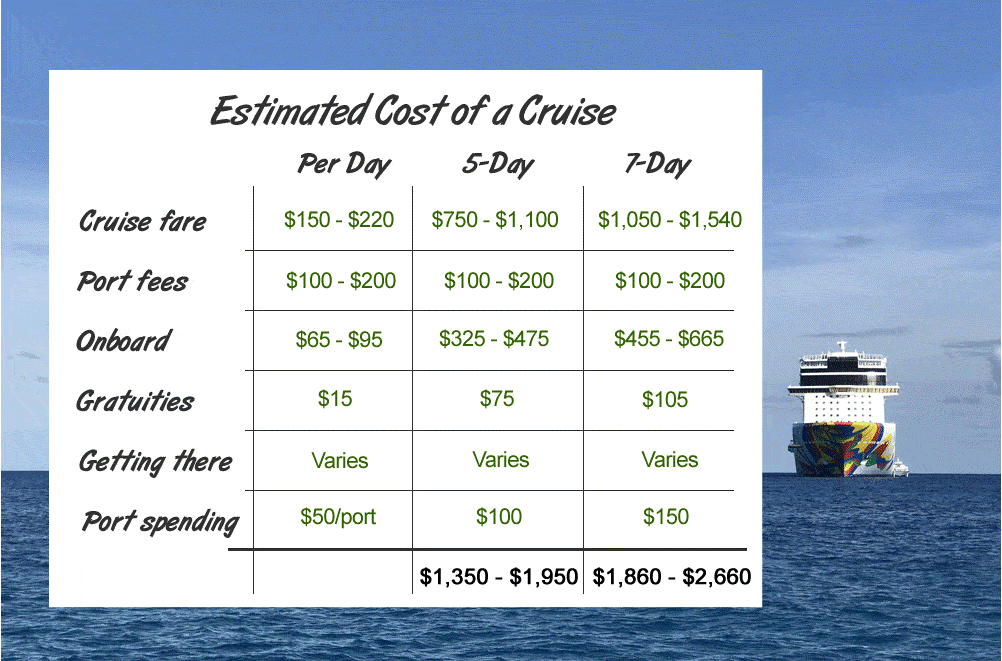
If we look at the average cost of one person to travel on a cruise for 7 days. According to Cruzely, the average cost per person for a 7 days trip can be around $2000, shorter cruise trips will cost around $1,500.
Source from:https://www.cruzely.com/how-much-a-cruise-costs-in-2020/
Now, let’s consider the cost of fuel consumption of the cruise. The size and the speed of the ship determined the fuel efficiency and total consumption. A larger ship traveling the same distance will still use more fuel than the smaller ones. According to online sources, generally speaking, a large cruise ship would consume up to 250 tons a day, if converted to gallons, it would be around 8000 gallons. Average-sized cruise ships can have a daily fuel consumption of between 140 and 150 tons. This means that the ship will be consuming 30 to 50 gallons per day per mile traveled.
A smaller-sized cruise ship costs about $80,000 per day on fuel. A larger cruise ship can cost up to $2 million per day to fuel.
P&O Britannia
The average speed of 21.9 knots is up to par with the course. The ship’s hourly fuel consumption of 3,000 gallons roughly estimates a fuel cost of $9,021. Roughly estimated Britannia has a fuel cost of around $216,504 per day.
Source from:https://boatinggeeks.com/how-much-does-it-cost-to-fuel-a-cruise-ship/
The net benefit for Britannia to travel for 7 days eliminated the maintenance fee of the ship and other supply fees, roughly calculated net benefits would be:
Total gain:
20004324 = $8648000
Fuel consumptions for 7 days:
216504 7=$1515528
Net benefit:
$8648000-$1515528 = $7132472
The Britannia ship can gain at most $ 7132472 roughly for one trip around 7 days.
Spirit of Discovery
Due to lack of data on total average consumption for the Spirit of discovery. We would use the estimate average smaller-sized cruise ship cost about $80,000 per day on fuel
Fuel consumption for 7 days: 80000 7 = 560000
Total gain:
2000999 = 1998000
Net benefit:
1998000-560000=$1438000
The Spirit of Discovery gains at most $1438000 roughly for one trip around 7 days.
The vital role of tourism in UK
According to the UK, tourism contributes £106 billion to the British economy & GDP and supports 2.6 million jobs. By 2025 the UK tourism industry will be worth over £257 billion, around 10% of the UK GDP. The industry supports 3.8 million jobs and has a huge impact on the UK economy. Tourism in London statistics demonstrates the popularity of the capital in comparison to other locations in the UK as the city has 8 times more visitors than the second most visited city. Holidays are the number one reason as to why tourists visit the UK, 63% of visits to the UK are for a holiday away.
There are some highlights characteristics about the tourism in UK
- Tourism is the fastest growing industry in Britain. It is expected to expand by 3.8% a year up until 2025, accounting for 10% of all jobs.
- £22.5 billion was spent by overseas travelers in the UK in 2016.
- Inbound tourism statistics recorded 37.9 million inbound visits to the UK in 2018, 3% less than 2017 which had 39.2 million.
- 118.6 million domestic overnight trips were made in the UK in 2018, down 2% vs. 2017.
- 9% of the UK’s GDP is generated by tourism.
- Inbound tourism to the UK has been recorded at £50 billion.
- 7 million overseas residents visited in April 2027. This is a 19% increase from the previous year.
- The number of outbound visitors from the UK totaled 72.8 million in 2018, a fall of 1% in 2017.
- Spain was the most popular destination for UK tourists, attracting 22% of all visitors.
- 53% of the inbound visitor spend is accounted for in London, the rest of England accounts for 35%, Scotland 8% and Wales 2%.
- A record-breaking £24.5 billion was spent by 2 million overseas visitors.
- Inbound tourism is set to grow from £21 billion in 2013 to £57 billion by 2025.
- UK tourism accounts for 7.2% of UK GDP.
Source from: https://www.condorferries.co.uk/uk-tourism-statistics
Design of Canals
Due to many uses of canals, the design of can be various as well. The structures become important in order to provide functions that ensures efficient water transfer and competently with minimum maintenance with minimum water leak. Irrigational canals require water can be effectively conveyed and regulated, especially being protected from storm runoff that may possibly damage the canal, causing flood events over agriculture fields. Canal that used in water transport need to have regulated canal discharge at the source of water supply, the rate of water flow can be an extremely importance factor that decided how efficiently barges and ships can carry and delivery commodities. To the contrary, the canal that used to generate hydroelectricity requires faster flow on order to produce sufficient energy. Lat but not the least, water quality is the most important factor for water supply canal to meet requirement for city and household use.
Some General requirements on regulation of canal discharge are primarily controlled by outflow through turnout structures. Where canal flow is to be divided and directed in several directions.
- Division structure are used to regulate the discharge in each direction.
- Wasteway structure also are used to control flow in a canal, however it is more comply used as a protective structure as their primary function is to discharge excess canal flows and thereby prevent overflow damage.
- Check structure, is used to raise the canal water level when canal water surface is low, so that a turnout structure may still deliver its designed capacity.
- External protection that protects the canal from damage by storm, runoff. Internal protection prevents excess canal flow caused by outside water entering the canal
- There are major structure components that made up a canal. For example – pipe. Pipe is commonly used for the part of a structure placed underground; it is made from one of several different materials such as reinforced concrete, asbestos cement. Welded steel, a corrugated metal or reinforced plastic mortar.
Suez Canal
The designed channel type is Trapezoid. By the end of 2015, after the latest Constuction of the Suez Canal, the total length of canal is measure to be 193.3km, and width measure at the surface of the canal to be 205 meters wide, width at 11m depth measured to be 113.3m. The maximum water depth is 24 meters, maximum loaded ship is reported as 240000 DWT. The capacity of the canal has increased at 2010 and enables the canal to accommodate 61% of Tanker Fleet, 92.7% of the Bulk carrier fleet, and 100% of the Container ships and other ships.
Total water storage(approximated)
193000*205*11=435215000 m^3 water
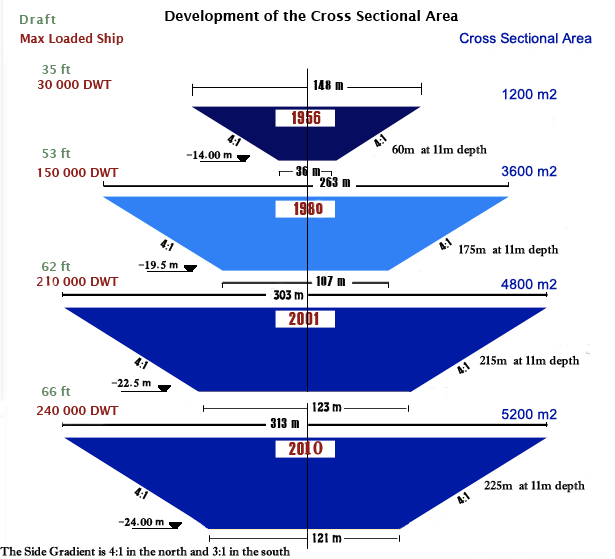
Because that the Suez Canal is an artificial sea level waterway, it is single-lane contains no lock which allows the water to flow through freely. Due to limited data available, I was unable to find the specific number that indicate the flow rate of the canal. But generally speaking, the canal north of the bitter lakes flows north in winter and south in summer. South of the lakes the current changes with the tide at Suez.
Panama Canal
The total length of Panama Canal after the expansion projected is reported as 82 km, the narrowest width of canal is 150 meter and at its widest point, the width of canal can be measured as 300 meters. The channel has an average depth of about 13 meters.
Minimum total water storage(approximated)
82000*150*13=159900000m^3
How much water does London need?
According to Mayor of London, there are more than 2.6 billion (26,000,000,000) litres of the water every day! Water is essential for city’s growth. However, with growing population and climate changes, the water crisis is being exacerbated in London. Construction on the propose canal along with dams and reservoir would create extra storage from millions of liters of water for London. This can effectively avoid water shortage in London. Beside building canal, the Mayors should also calls on all water suppliers in London to cut leaks from their system by 50% by 2050, especially focus on the burst water pipe that contribute to the most leakage. Also, The Mayor should call upon the Environment Agency and investor to grant permission at reservoir and dam constructions to prevent water crisis in London future.
Characteristics of proposed canal:
Route 1: Hertford to Cambridge.
Total estimated length between Hertford to Cambridge: ~30 miles (48.3 km)
Width: ~200
Depth: ~15
Total water capacity(approximation)
48300*200*15= 144,900,000 m^3
Route 2: Port of Immingham
Total estimated length from Immingham to Lincoln: ~30 miles
Width: ~200
Depth: ~15
Total water capacity(approximation)
48300*200*15= 144,900,000 m^3
Route 3: connecting the River Ouse in Bedford to the Grand Union Canal in Milton Keynes
Length: 17 miles, which is 27.4 km
Width: ~200
Depth: ~15
Total water capacity(approximation)
27400*200*15=82,200,000 m^3
https://www.usbr.gov/tsc/techreferences/mands/mands-pdfs/SmallCanals.pdf